Pricing
Public betaOne seat.
Your whole team.
Pay for what the AI does. Not for who logs in. The model is a metered utility; the memory it reads is yours to keep.
$99/month
for the Owner’s seat, then cost-plus the token meter.
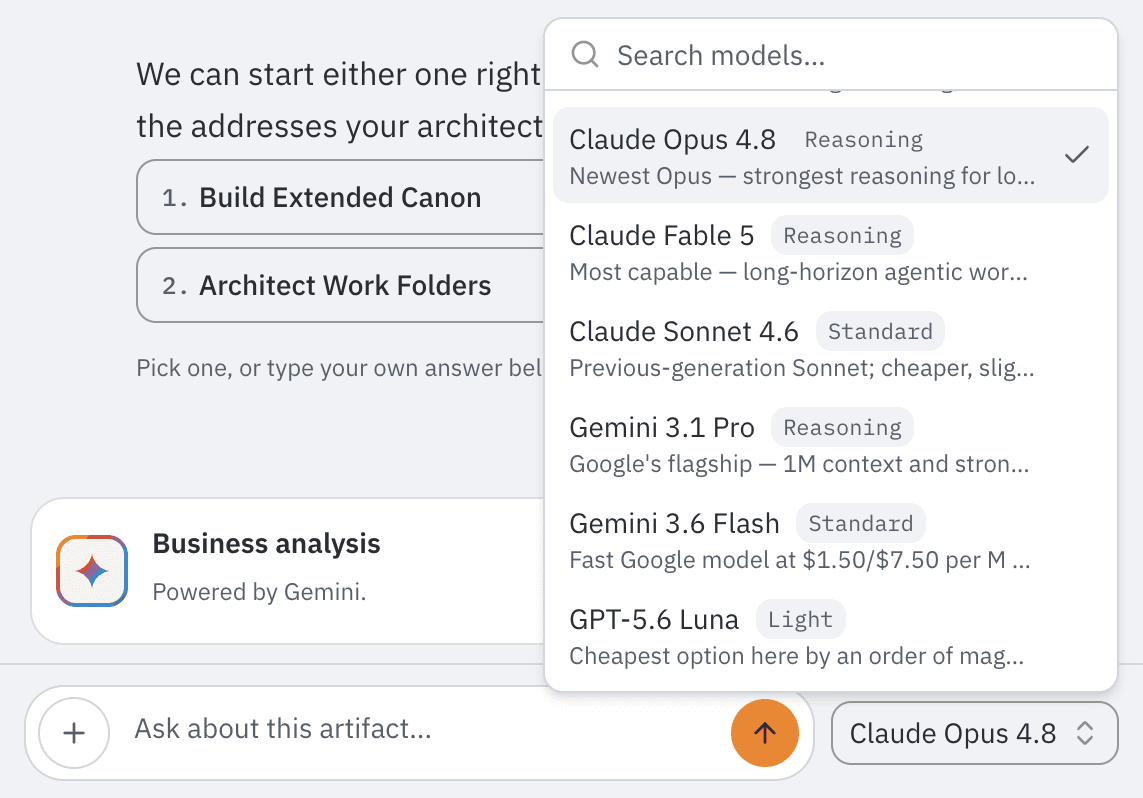
Model-agnostic
One seat. Eight models.
Secure, governed knowledge at a single-seat rate, plugged into 8 commercial models — two Sonnet, two Opus, Fable, two Gemini, and GPT. Voice runs through GPT; Gemini gives Workspace a second read for analysis.
Usage across all of them meters at cost-plus — transparent to the token, itemized as it runs.
Ownership
Seat 1 is the Owner.
The Owner authors the First Fifteen Memories and your Memory Architecture, then invites System Librarians and Team Members. There’s no second seat to buy — collaborators join under your team usage.
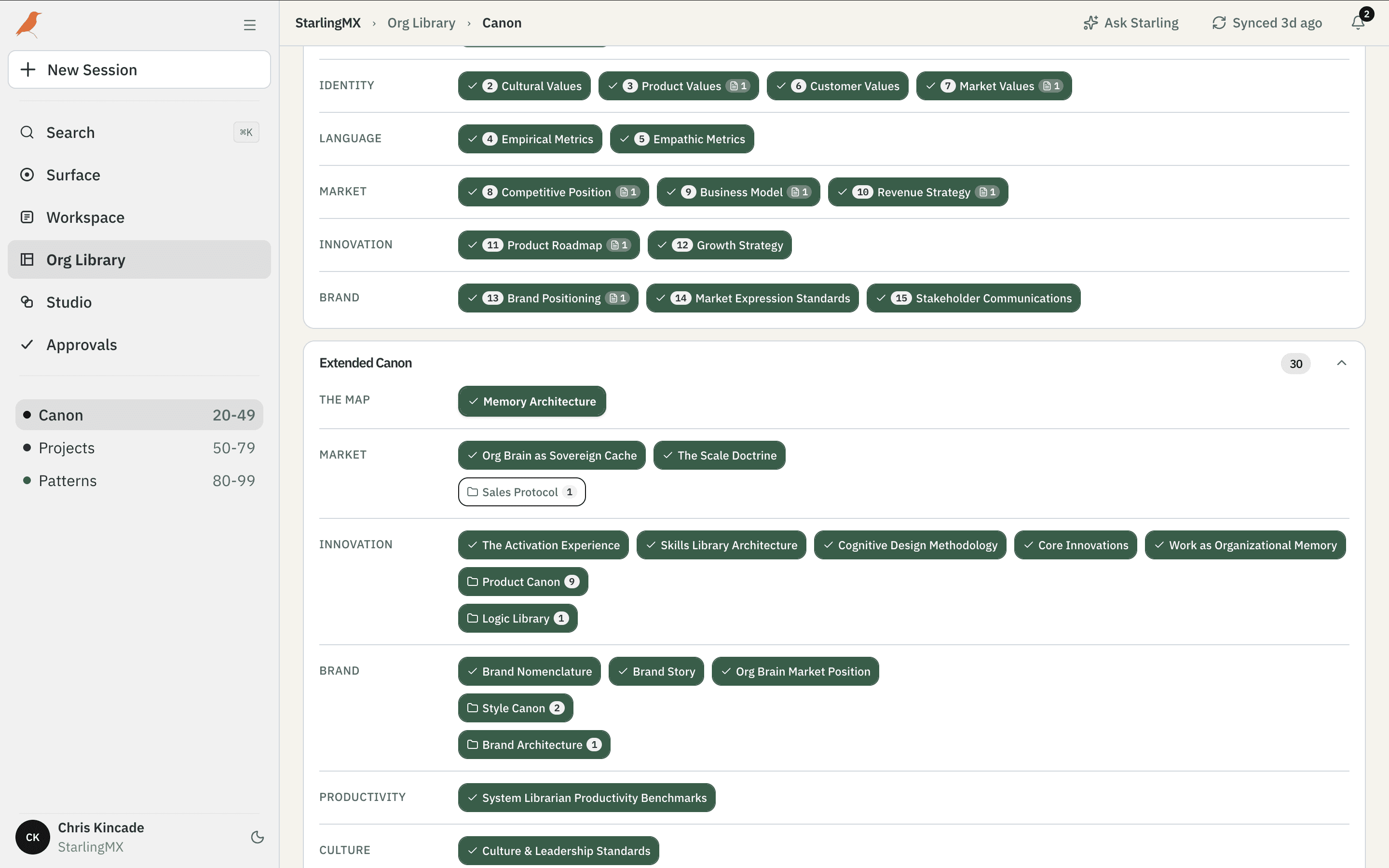
Nests
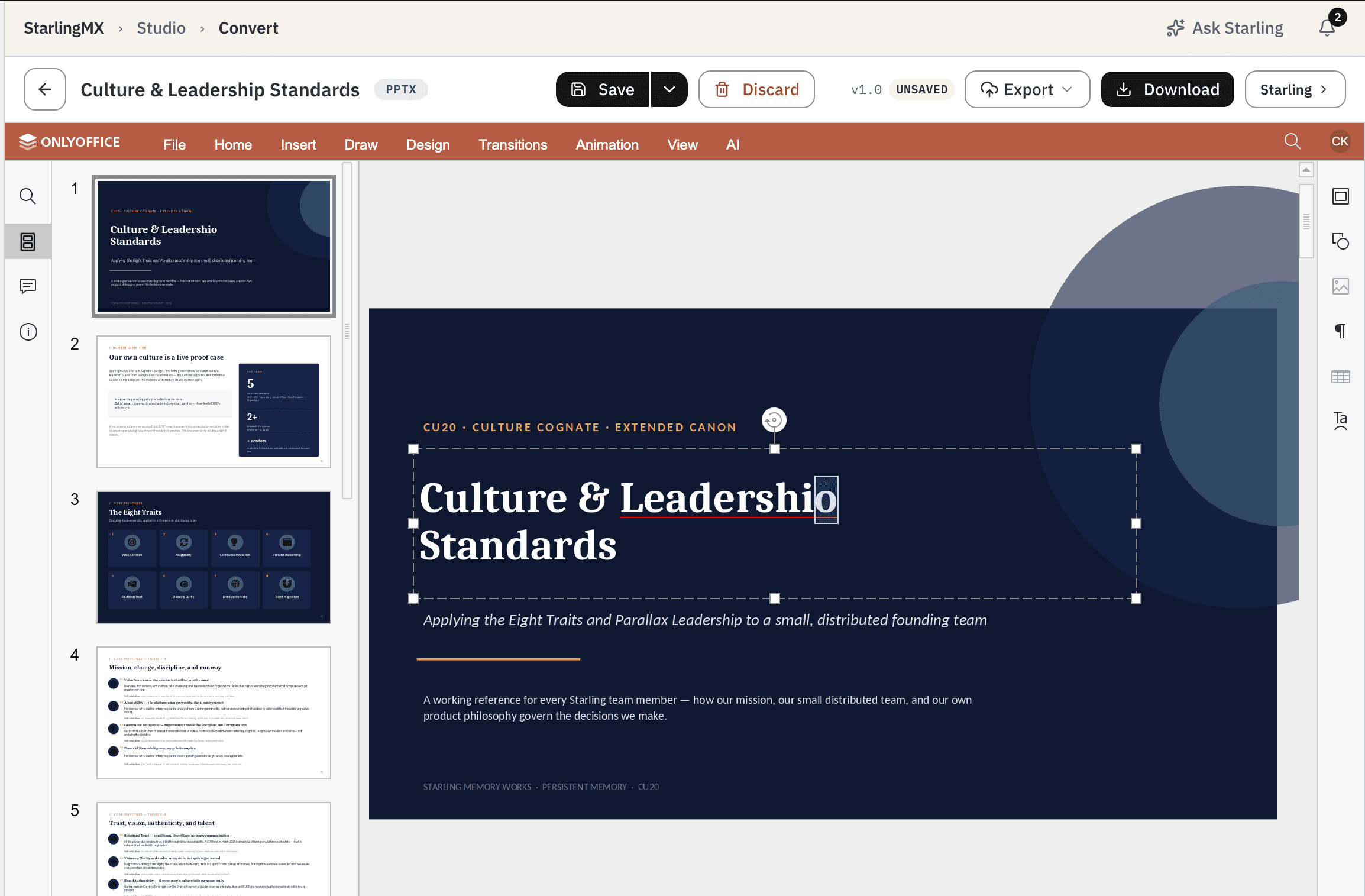
Dual repositories: Memory and outputs, separated for token efficiency.
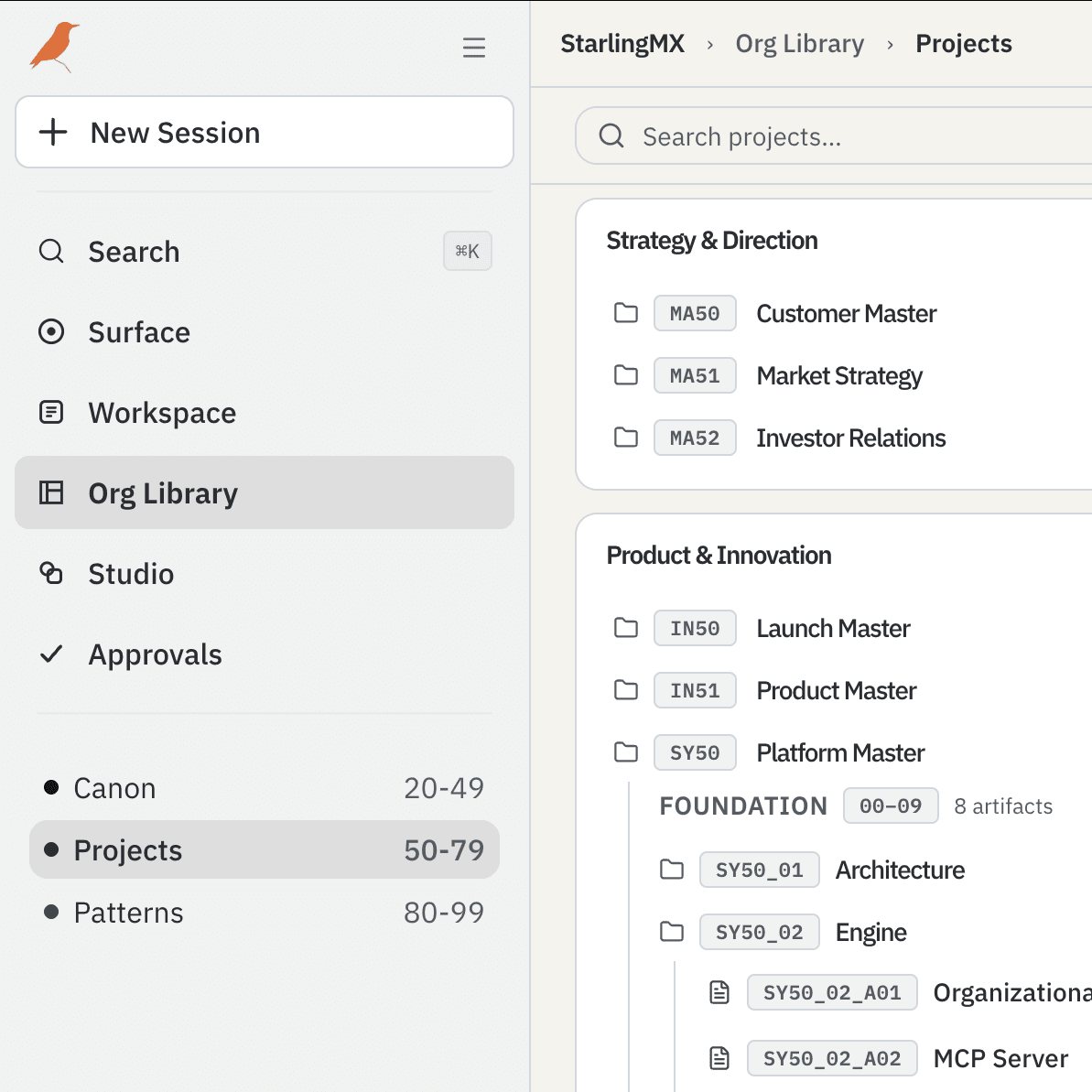
Org Library · lossless memory
System Librarians manage and permission the Org Library — your lossless memory. Studio holds your lossy outputs: incoming reference sets for analysis and outgoing documents that leave the building, plus your brand assets and style sheet.
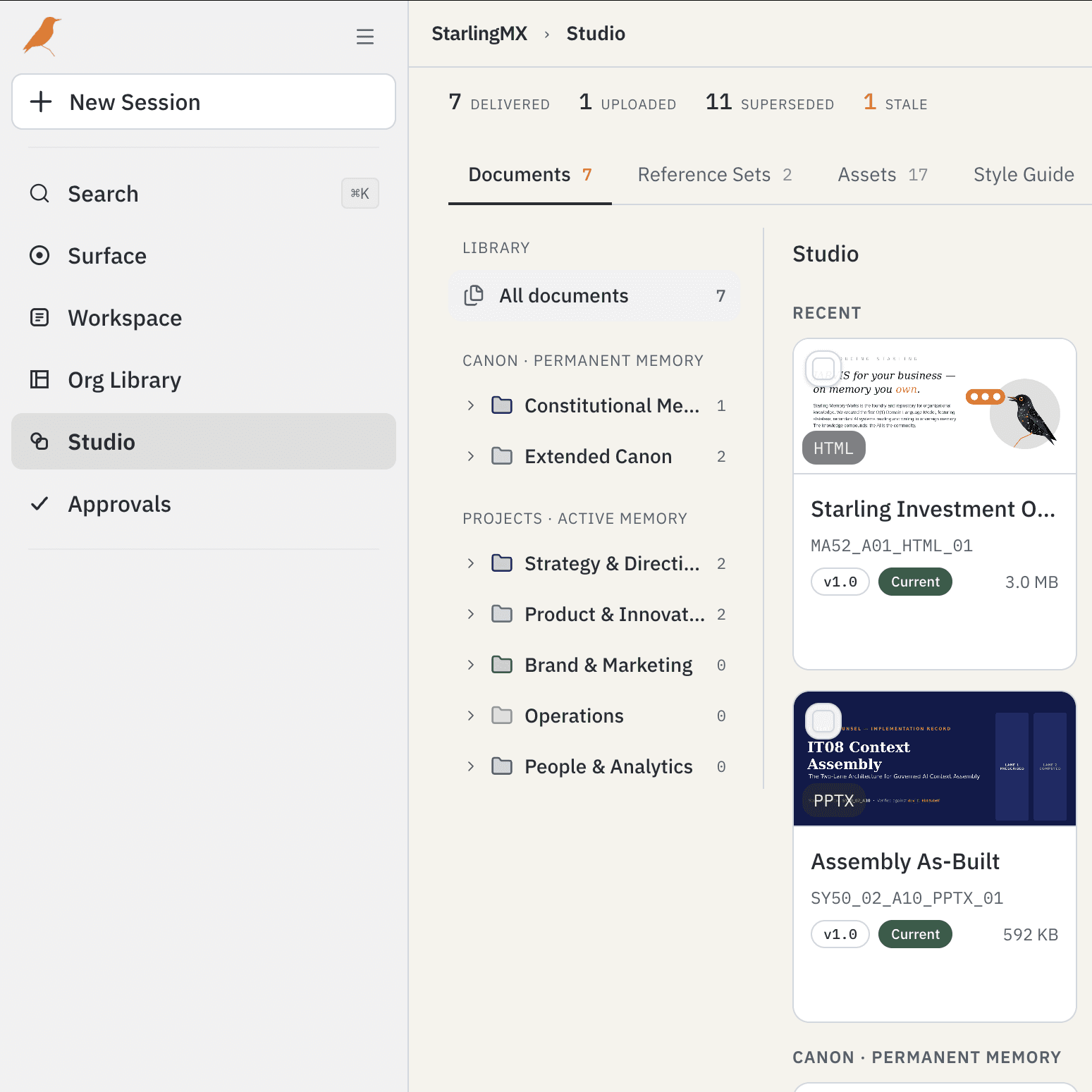
Studio · lossy outputs
We call our repositories Nests, because there are two, separated to isolate where tokens are spent — converting between lossy documents and lossless memory. Prefer Notion? Starling runs on your own Notion too — a separate subscription, no migration.
An AI-Native Workflow
How a Chief of Staff operates.
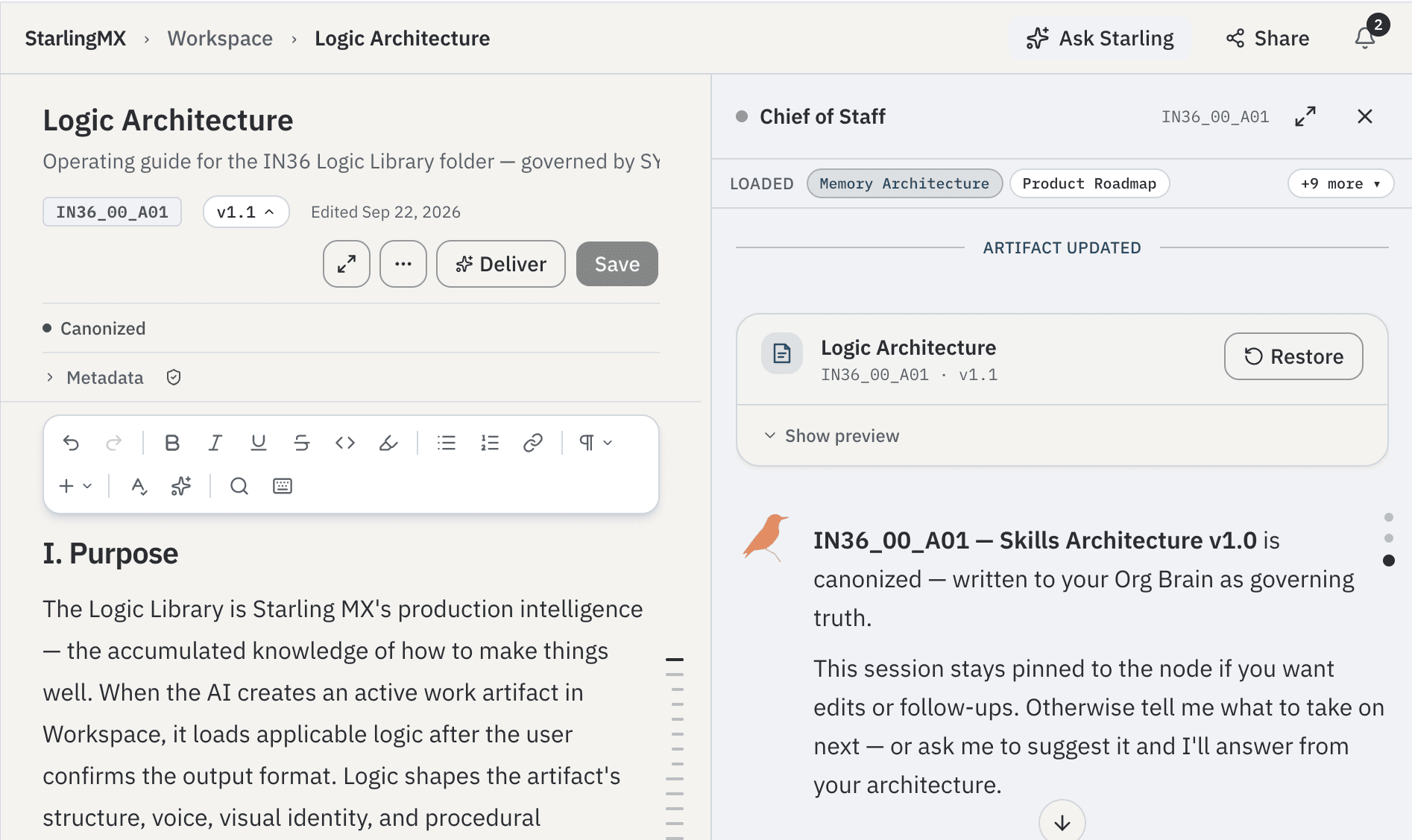
Work begins in Workspace, where you create a memory artifact. Explain what needs to be produced and work out the beats on your own or with Starling. You can type in the artifact directly.
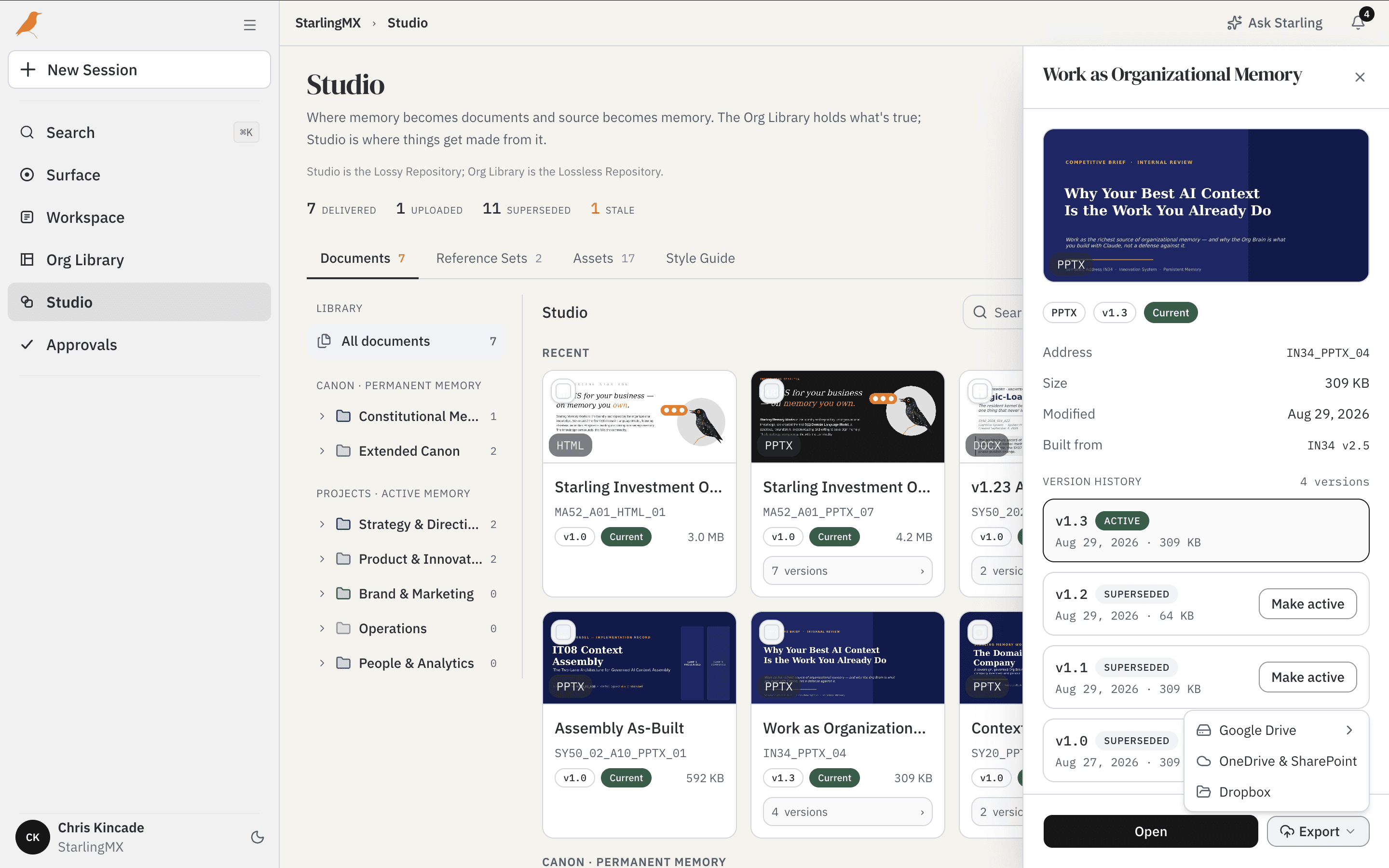
When you’re ready to distribute, have Starling Deliver a PowerPoint, a company-wide memo, your P&L, a website, a strategy doc, an employee handbook, and more. You pick the output format, name the assets to embed, and Starling generates the draft. The original memory is memorialized in a watermark, so provenance is traceable.
Edit & govern
Edit by hand. Write-back to avoid drift.
Use the model for big moves like a theme change; use Edit mode to change things by hand.
Starling uniquely has write-back. When you take an idea well past the original memory, Steward mode surfaces the difference so it can flow back into canon.
What it costs
Pay for the work, not the headcount.
Your team’s usage meters cost-plus from one prepaid pool that scales with the work. Your Nests are included; Notion requires a separate subscription.
Starling fits the stack you already have. Studio imports from and exports to Google Drive, OneDrive, and Dropbox, and produces native Microsoft Office files — so work lands where your team already works, in the formats they already use.
What it runs
Sized to your work, capped by you.
Usage tracks the finished work your team produces, not who logs in — a prepaid pool you cap, with every cost shown before you run it. Ask Starling for your provisional monthly range.
Why now
It stopped being hypothetical.
When memory lives inside the model, the AI system rules your infrastructure. Starling moves memory to the top of stack, where it is secured by architecture, not a legal agreement. Context is assembled before the model is ever called, so the AI reads what it needs and holds nothing.
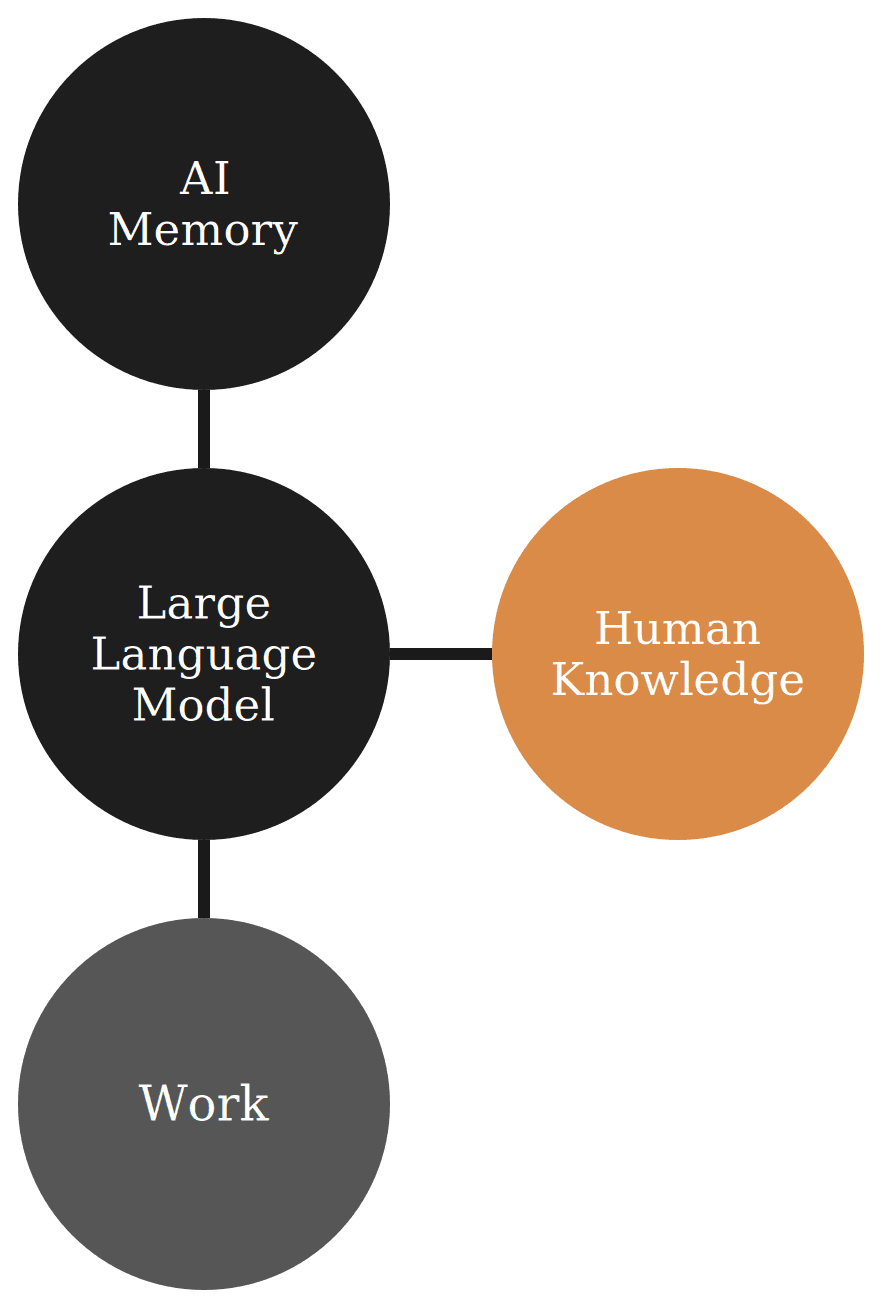
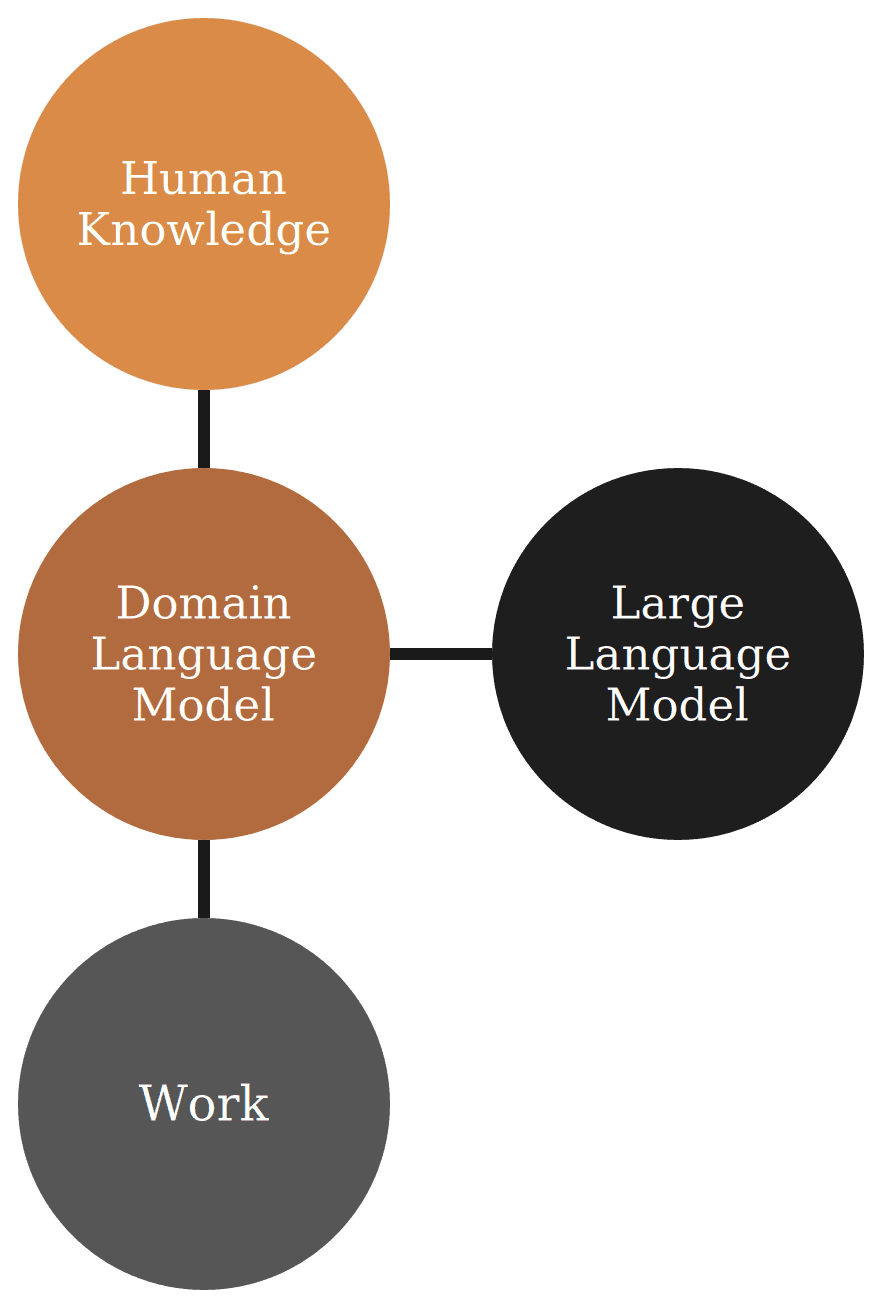
The two panels show the same four parts stacked two ways. On the left, the problem: the model sits in the middle, wired to everything — its memory above it, your knowledge off to the side as one more input, the work below. Swap the model and all of it goes with it.
On the right, the fix: your knowledge moves to the top, held in a Domain Language Model, in memory you own. There’s no separate AI memory now — the memory is your knowledge. The large language model drops to the side, swappable for any other, and the work writes back into what’s yours.
Problem
Solution
How it’s priced
One seat. Your whole team. Metered at cost.
Free — the UCA standard. The filing system for what your business knows. Write yourself down, turn the model’s memory off. Free forever — a standard, not a trial.
$99/month + metered team usage — Starling MX. One Owner seat. Usage is metered cost-plus from a shared pool, on any model you select.
Enterprise — designed and staffed. We architect your Org Brain, wire it into the stack you already run, and deploy it in your own cloud. Custom.
No per-seat tax. You pay for what the AI does — on any model, on memory you own. Your first month builds the Org Brain; the months after run it.
Your first month builds it. Cancel any time and it stays yours.
FAQs
What you need to know
Something else on your mind? Send us a note. We respond within a business day.
Plug in.
Two ways to start — pick yours.
Become an Owner
$99 for month one builds a functional Chief of Staff and portable memory set for AI systems.
Large organization
Bringing this to a big, regulated organization? We’ll design and staff it with you.
Great startups
If your startup will make a great case study, pitch me — and I’ll give you access on me.
Pitch us